𝔄𝔩𝔟𝔦𝔫𝔦𝔰𝔦𝔪, 𝔏𝔢𝔲𝔠𝔦𝔰𝔪, 𝔞𝔫𝔡 𝔉𝔞𝔢 ℑ𝔪𝔭𝔯𝔦𝔫𝔱𝔢𝔡 𝔊𝔢𝔫𝔢𝔱𝔦𝔠 𝔐𝔲𝔱𝔞𝔱𝔦𝔬𝔫𝔰
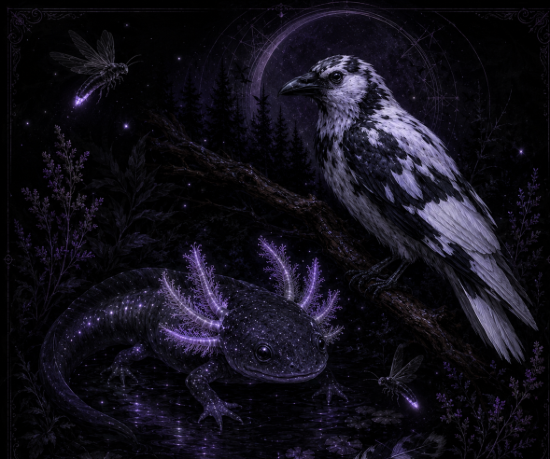
𝔖𝔬𝔪𝔢 𝔠𝔯𝔢𝔞𝔱𝔲𝔯𝔢𝔰 𝔞𝔯𝔯𝔦𝔳𝔢 𝔠𝔞𝔯𝔯𝔶𝔦𝔫𝔤 𝔥𝔦𝔡𝔡𝔢𝔫 𝔩𝔦𝔤𝔥𝔱. 𝔒𝔱𝔥𝔢𝔯𝔰 𝔠𝔞𝔯𝔯𝔶 𝔱𝔥𝔢 𝔪𝔢𝔪𝔬𝔯𝔶𝔶 𝔬𝔣 𝔣𝔦𝔯𝔢. 𝔗𝔥𝔯𝔬𝔲𝔤𝔥 𝔱𝔥𝔢 𝔩𝔢𝔲𝔠𝔦𝔰𝔱𝔦𝔠 𝔠𝔯𝔬𝔴 𝔞𝔫𝔡 𝔱𝔥𝔢 𝔣𝔦𝔯𝔢𝔣𝔩𝔶 𝔄𝔵𝔬𝔩𝔬𝔱𝔩, 𝔱𝔥𝔦𝔰 𝔢𝔫𝔱𝔯𝔶 𝔢𝔵𝔭𝔩𝔬𝔯𝔢𝔰 𝔪𝔲𝔱𝔞𝔱𝔦𝔬𝔫, 𝔪𝔶𝔱𝔥, 𝔞𝔫𝔡 𝔥𝔦𝔡𝔡𝔢𝔫 𝔦𝔩𝔩𝔲𝔪𝔦𝔫𝔞𝔱𝔦𝔬𝔫- 𝔣𝔬𝔩𝔩𝔬𝔴𝔦𝔫𝔤 𝔱𝔥𝔢 𝔰𝔱𝔯𝔞𝔫𝔤𝔢 𝔭𝔩𝔞𝔠𝔢𝔰 𝔴𝔥𝔢𝔯𝔢 𝔟𝔦𝔬𝔩𝔬𝔤𝔶 𝔯𝔢𝔪𝔢𝔪𝔟𝔢𝔯𝔰 𝔰𝔱𝔬𝔯𝔶, 𝔞𝔫𝔡 𝔰𝔭𝔦𝔯𝔦𝔱 𝔯𝔢𝔪𝔢𝔪𝔟𝔢𝔯𝔰 𝔭𝔞𝔱𝔱𝔢𝔯𝔫. 𝔄 𝔭𝔦𝔢𝔠𝔢 𝔬𝔫 𝔱𝔯𝔞𝔫𝔰𝔣𝔬𝔯𝔪𝔞𝔱𝔦𝔬𝔫, 𝔱𝔥𝔢 𝔰𝔭𝔦𝔯𝔦𝔱 𝔦𝔰 𝔪𝔞𝔯𝔨𝔢𝔡, 𝔞𝔫𝔡 𝔱𝔥𝔢 𝔟𝔬𝔡𝔶 𝔰𝔭𝔢𝔞𝔨 𝔱𝔥𝔢 𝔰𝔠𝔞𝔯. 𝔄𝔰 𝔴𝔦𝔱𝔥𝔦𝔫, 𝔰𝔬 𝔴𝔦𝔱𝔥𝔬𝔲𝔱.
There are certain creatures that seem as though nature has written a different version of itself upon them.
A pale crow. A white animal with familiar eyes. An axolotl carrying colors that seem borrowed from another realm. These beings appear at the edge of expectation, not as mistakes of nature, but as alternate expressions of it.
The study of albinism and leucism begins with pigment, but it does not end there. Within these mutations are stories of absence, revelation, transformation, and the visible marks left upon living beings.
Albinism is a condition involving reduced or absent melanin production. The animal’s coloration changes because a fundamental pigment does not manifest in the expected way. Often the eyes reveal this absence, becoming pale, pink, or red as the underlying structures become visible.
Leucism follows a different path.
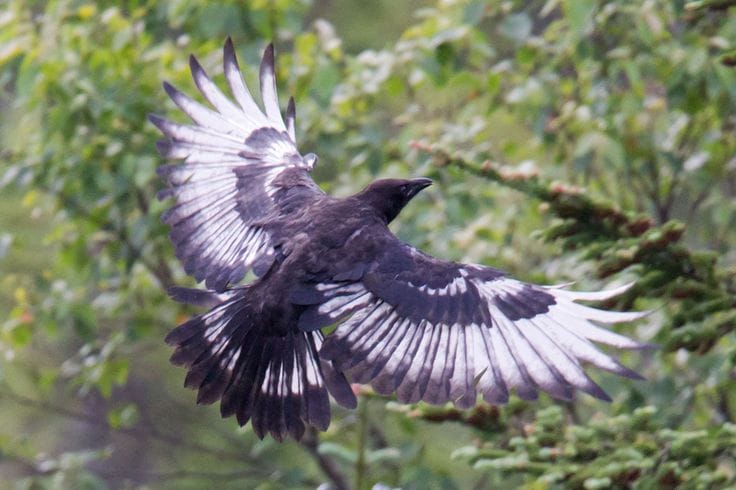
In leucism, pigment cells are disrupted in their distribution throughout the body. The creature may become pale, white, or partially marked while retaining its original eye coloration.
The difference is subtle, but the impression is profound.
The albino creature carries the signature of what cannot be produced.
The leucistic creature carries the revelation of what was always present, but expressed differently.
A leucistic crow does not cease to be a crow.
It remains the watcher. The intelligent one. The messenger. The creature that moves between worlds of sky, earth, life, and decay. Yet its familiar darkness is altered, revealing another expression beneath what was expected.
And the crow was never truly only black.
Within corvid feathers exist hidden colors. Beneath the darkness are flashes of violet, blue, green, and metallic tones revealed when light strikes at the correct angle. The black feather is not empty of color; it is a vessel containing colors hidden until the right moment.
This creates an interesting possibility within the relationship between leucism and folklore of the white crow.
Leucism changes the distribution of visible pigment, but the structures responsible for the feather’s interaction with light exist through a different process. A leucistic crow may lose the darkness normally associated with melanin while still carrying the architecture that allows the corvid feather to reveal hidden colors.
The result is not simply a white bird.
It is a crow whose hidden spectrum may become more visible.
The same feather that appears black under ordinary conditions can reveal violet, blue, green, and metallic flashes when illuminated correctly. A leucistic crow presents an inversion of this: the darkness is reduced, allowing the underlying complexity of the feather to become more apparent.
In this way, the leucistic crow becomes a fascinating meeting point between biology and myth.
The white crow of legend may be understood not as a creature lacking the essence of the crow, but as another expression of the crow’s own hidden possibilities.
Across mythology, there are traditions describing the crow as a bird that was once white or brightly colored before being transformed through fire, divine encounter, or consequence. The "brightly colored" in this cannon could be the remaining Eumelanin + organized melanosomes + feather microstructures reflecting light. Moreover if we look at a partially leucistic crows where single feathers show traits of leucistic colouring and its normal Eumelanin black, it gives a very "scorched" looking corvid. the black patches or single feathers resembling a charred feather.
In Greek tradition, one story tells of the crow once bearing white feathers before an encounter with Apollo transformed the bird through fire. The black feathers become not simply a color, but a record of transformation — a mark left by an encounter with divine force.
This raises a question:
Could some of these ancient images of the white crow have been inspired by rare natural variations?
A leucistic crow offers a fascinating possibility. A bird altered in pigment, yet still carrying the underlying structure of the corvid feather, could reveal another expression of the same being. The darkness may fade while the hidden architecture responsible for iridescent flashes remains, allowing hints of violet, blue, green, or metallic color to emerge beneath a pale surface.
The white crow of legend may not represent a creature separate from the crow. It may represent the crow before the world recognized its darker form. Not an absence of crow, but another manifestation of crow. The black crow already carries hidden colors. The leucistic crow reveals them differently. The myth remembers the transformation. The feather remembers the light. This same principle appears throughout nature.
In the axolotl, color is shaped by specialized pigment cells called chromatophores. Melanophores create darker tones, xanthophores create yellow and gold coloration, and iridophores create reflective, shimmering qualities. The iridescent appearance does not come from a single “magic color,” but from microscopic structures interacting with light.
The creature carries hidden brilliance within its own body.
The firefly axolotl takes this even further. Under specific lighting conditions, fluorescent proteins reveal a glow that was already present but invisible to ordinary sight.
A hidden light waiting for the correct key.
There is something deeply familiar about this pattern.
Across folklore, the unseen becoming visible is often associated with revelation, enchantment, and crossing a boundary between ordinary perception and deeper awareness.
The axolotl itself is a creature of thresholds.
An amphibian that remains suspended in its juvenile form, it exists between states. It belongs to water but carries the lineage of land-dwelling salamanders. It is a creature that refuses the expected path of transformation and instead creates another path entirely. Here the motif of Fae being forever young appearing, or when brought to their world time ceases to exist or the human who ate the food does not age at all within their reality, but 5 years may have passed in ours.
This quality is part of what gives it a fae imprint.
Not simply because it is beautiful or unusual, but because it embodies the characteristics often associated with beings of the hidden realms: liminality, transformation, altered states, and existing between categories.
The old stories of the fae often revolve around boundaries.
Forest edges.
Rivers.
Twilight.
Places where one thing becomes another.
The axolotl feels like a creature from that same symbolic territory — a being that lives in the space between forms.
The crow carries a different element of this mystery.
Where the axolotl belongs to water and hidden transformation, the corvid belongs to air, memory, intelligence, and the unseen. Across many traditions, crows and ravens appear as figures of knowledge, creation, prophecy, trickery, and communication between worlds.
Their intelligence is part of what makes them powerful symbols. They observe. They remember. They adapt. They exist beside humanity while remaining fundamentally wild. Here another motif lays as fairies are seen as humans but in an uncanny way, they sometimes act, speak, and have similar motives as humans do. But they are wild people to us, living in the elements with different morals and rules to how their society works. However it is a difference we can familiarize our self with.
This is why the corvid appears so often in myth.
In some Indigenous traditions of North America, crow and raven stories involve the carrying of fire, light, or essential knowledge into the world. The darkening of the bird is not only loss; it is the visible sign of a burden carried and a gift delivered.
The crow becomes a creature marked by what it has endured.
The same current appears through other members of the corvid family.
In European Christian folklore, the magpie is associated with a legend of the Crucifixion in which the Magpie sits upon the left arm of the cross of which Jesus is hung. And as all the birds and animals cry and mourn for Jesus the magpie remains apart by staying in silence, at this moment the magpie becomes Lucifer's prince bird of hell. From this silence came associations with pride, witchcraft, and the Devil. Another interpretation can also emerge from the same story: the magpie as observer, the creature that refuses performance, the intelligence that stands outside expectation. Again the behavioral aspects of the good folk (fae) we see similar attributes.
The corvid current expresses itself through many forms.
Biologically, corvid refers to a family of birds. Symbolically, it can be understood as a shared current expressed through crow, raven, magpie, rook, and others — each carrying its own myths, behaviors, and relationships with humanity.
The pale crow and the luminous axolotl are not connected by blood or evolution.
They are connected by pattern.
Both are examples of nature revealing hidden possibilities. Both remind us that the world is not limited to the first version of a thing we encounter.
Some beings are marked by fire. Some are marked by absence. Some are marked by hidden light.
Some carry the imprint of another path from the moment they enter the world. Mutation is not merely deviation.
Scientifically, mutation is one of the forces through which life changes, adapts, and reveals possibilities that were not previously visible. Spiritually, mutation can be understood as a marking — a strange and fascinating imprint upon a being that makes it stand apart.
A creature altered through unseen forces, whether through science, spirit, or porque no — los dos? Why not both? — becomes a reminder that there is beauty and revelation hidden within every form of existence.
The spirit is marked, and the body speaks the scar.
As within, so without.
The fae have always carried this same contradiction. They are beautiful and hypnotic, but they are also terrible and strange. They can be gentle or dangerous, enchanting or frightening, depending upon the landscape, the conditions, and the relationship between themselves and the world they inhabit.
In many traditions, fae beings are associated with animals — inhabiting them, riding alongside them, or taking their forms. The boundary between creature and spirit becomes uncertain. The animal becomes something more than itself. And when such a being is encountered, there is often something subtly uncanny about it. The eyes may appear almost too aware. The behavior may resemble human intention too closely. The voice, movement, or intelligence may approach something familiar while remaining unmistakably other. What we now describe through the language of science as genetic variation, anomaly, or mutation has often existed within folklore as transformation, enchantment, or fae imprint.
Mutation is one expression of hidden possibility. The fae imprint is another.
Deviation is not absence. Deviation is revelation.
As within, so without.